Underground Car Parks — Among the Most Hazardous Fire Environments
Underground car parks are among the most hazardous fire environments in modern buildings. With no natural ventilation and limited access for firefighting, smoke can accumulate rapidly — creating life-threatening conditions within minutes.
The close proximity of vehicles increases the likelihood of fire spreading from one car to another, further intensifying the risk. In such scenarios, uncontrolled smoke — not flames — is the primary threat to occupant safety.
Simulating a Real Fire Before It Happens
A detailed fire scenario was developed using Fire Dynamics Simulator (FDS) — a globally recognised CFD tool for fire and smoke modelling. The simulation was configured to reflect realistic underground car park conditions:
- A credible car fire with a fast growth rate was modelled
- Realistic underground conditions were fully simulated
- Jet fans and mechanical smoke extract systems were incorporated
- Transient analysis performed to track smoke spread over time
How Smoke Really Behaves in a Car Park
The FDS simulation revealed critical insights into smoke behaviour under a fast-growth car fire scenario:
- Smoke spreads rapidly across the ceiling and fills the space within minutes
- Visibility reduces significantly, impacting evacuation routes
- Heat and toxic gases quickly create untenable conditions
- Without proper ventilation, smoke stagnation becomes critical
Engineered Smoke Control That Works
With an optimised ventilation design incorporating jet fans and mechanical extraction, the simulation demonstrated significant improvements in smoke management performance:
- Jet fans effectively direct smoke towards extract points
- Escape paths remain clearer for a longer duration
- Smoke is removed efficiently from the space
- Back-layering and smoke stagnation are minimised
From Chaos to Controlled Environment
The optimised smoke control design delivers measurable improvements in life safety performance across the entire car park level:
- Improved life safety for occupants during evacuation
- Enhanced visibility along designated escape routes
- Faster smoke clearance from the occupied space
- Better conditions for firefighting operations
Designing for Real Fires, Not Just Code Compliance
A design that meets code requirements does not always guarantee real-world performance. Using CFD-based analysis, we ensure that smoke control systems are validated against realistic fire conditions — going beyond prescriptive code to deliver true performance-based fire safety.
This study demonstrates a critical principle in underground car park fire safety:
Code compliance alone is not enough.
By using FDS-based CFD simulation, risks are identified early in the design stage, smoke control systems are optimised for realistic fire conditions, and solutions are validated for both safety and performance — ensuring the system works when it matters most.
CFD Smoke Simulation Result
Underground Car Park Fire Scenario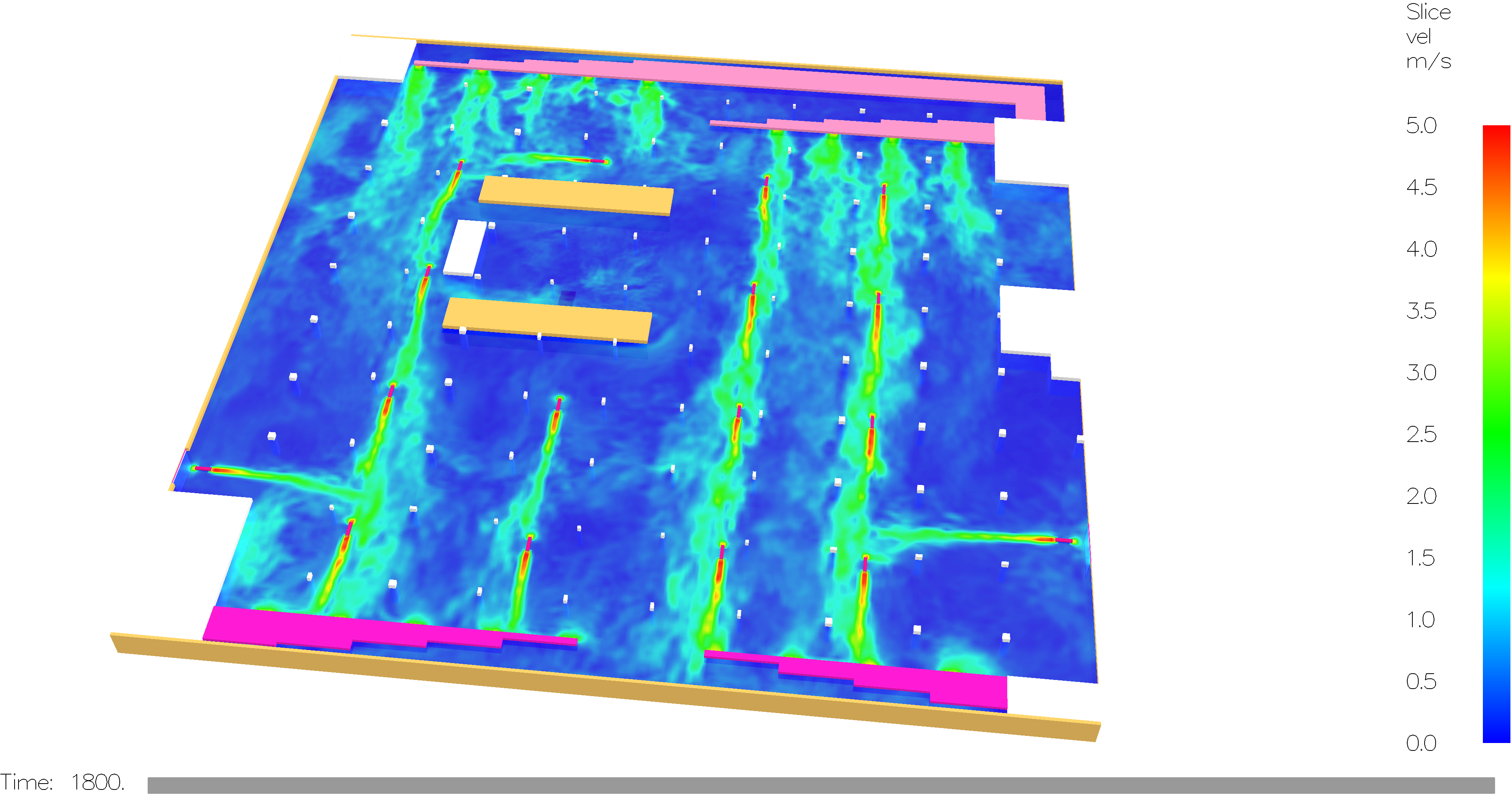
Optimised Smoke Control System Performance
CFD simulation demonstrates the effectiveness of the jet fan ventilation system in directing smoke towards extraction points, maintaining tenable evacuation conditions and improving visibility during a fire event.